Each year over 55,000 men are diagnosed with prostate cancer. Sadly about 12,000 men will die from the disease but many will also recover. We hope that you find the following information useful and encourage you to contact our nurses to discuss your health concerns.
Whilst we at Orchid use the term ‘male cancer’ we recognise that this language might be dysphoric for the transgender and non-binary community affected by prostate cancer.
What is the Prostate?
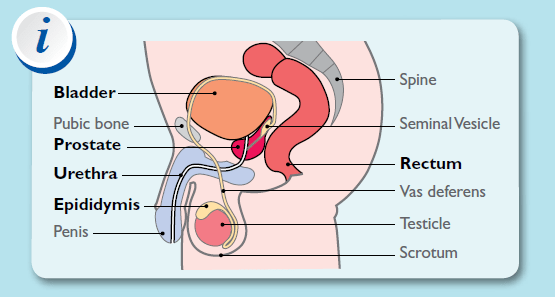
The prostate gland is located inside the body behind the penis and below the bladder. It is only found in males. It is tiny at birth but grows after puberty due to rising levels of the male hormone, testosterone.
The prostate has structures called seminal vesicles attached to it. These seminal vesicles secrete around 60% of the fluid that is needed to produce male semen, the fluid that men produce when they ejaculate.
What are the Causes?
Cancer of the prostate occurs when normal, healthy cells, which are carefully regulated in the body, begin to reproduce uncontrollably in the prostate gland.
In most cases, this type of cancer grows slowly and sometimes goes unnoticed for years. This is because it can cause very few symptoms. In some cases, however, it can progress more quickly and may spread to other parts of the body.
What are the Symptoms?
There is no single symptom to suggest prostate cancer. The most common symptom that people have heard of is difficulty with urinating (peeing) but some patients do not experience this at all. Early prostate cancer does not tend to affect the urethra or waterpipe and so urinary symptoms will not be present.
Some men who do not have prostate cancer may have problems urinating but this can be due to non-cancerous enlargement of the prostate gland as men get older, or problems with the urethra or bladder.
Men who are experiencing any problems passing urine including a slow, interrupted stream of urine, difficulty starting and stopping urination, blood in the urine, discomfort or pain should see their GP as soon as possible. If there is a risk of prostate cancer men will be referred to a hospital specilaist called a urologist for further investigation.
Living with Prostate Cancer Video
We invited a group of men and their partners to talk about how life has changed since being diagnosed. They share some of their personal experiences, challenges, fears and hopes in this engaging film.
To provide the best experiences, we use technologies like cookies to store and/or access device information. Consenting to these technologies will allow us to process data such as browsing behaviour or unique IDs on this site. Not consenting or withdrawing consent, may adversely affect certain features and functions.
Functional
Always active
The technical storage or access is strictly necessary for the legitimate purpose of enabling the use of a specific service explicitly requested by the subscriber or user, or for the sole purpose of carrying out the transmission of a communication over an electronic communications network.
Preferences
The technical storage or access is necessary for the legitimate purpose of storing preferences that are not requested by the subscriber or user.
Statistics
The technical storage or access that is used exclusively for statistical purposes.The technical storage or access that is used exclusively for anonymous statistical purposes. Without a subpoena, voluntary compliance on the part of your Internet Service Provider, or additional records from a third party, information stored or retrieved for this purpose alone cannot usually be used to identify you.
Marketing
The technical storage or access is required to create user profiles to send advertising, or to track the user on a website or across several websites for similar marketing purposes.